

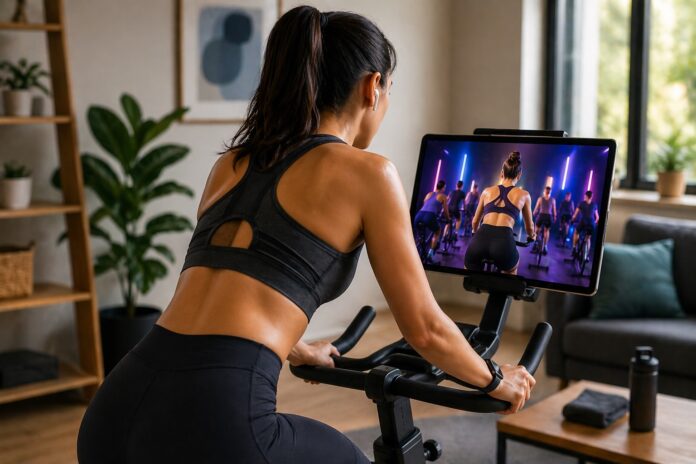
Staring at a blank wall while pedaling a stationary bike is one of the fastest ways to quit cycling altogether. If that sounds familiar, you’re not alone — and thankfully, indoor cycling apps have made serious strides in 2026.
Whether you’re riding a smart trainer, a basic spin bike, or a high-end Peloton, the right app transforms a monotonous indoor session into something you actually look forward to. After testing the most popular platforms across different bike setups and fitness levels, here’s exactly what’s worth your time — and your money.
Updated for 2026 | Tested across smart trainers, spin bikes, and connected devices
Quick Comparison
| App | Price | Platform | Best For | Rating |
|---|---|---|---|---|
| Zwift | $19.99/mo | iOS, Android, PC, Mac | Gamified training & racing | ⭐ 4.8/5 |
| Peloton App | $12.99/mo | iOS, Android, Web | Instructor-led classes | ⭐ 4.6/5 |
| TrainerRoad | $19.99/mo | iOS, Android, PC | Structured performance training | ⭐ 4.7/5 |
| Wahoo SYSTM | $14.99/mo | iOS, Android, PC | Data-driven serious cyclists | ⭐ 4.5/5 |
| Rouvy | $10/mo | iOS, Android, PC | AR video route riding | ⭐ 4.3/5 |
| Sufferfest (via SYSTM) | Included in SYSTM | iOS, Android | Mental + physical training | ⭐ 4.4/5 |
| Apple Fitness+ | $9.99/mo | iOS only | Apple Watch cyclists | ⭐ 4.3/5 |
| Kinomap | $9.99/mo | iOS, Android | Real-world video routes | ⭐ 4.1/5 |
Best Indoor Cycling Apps in 2026
Zwift — Best Overall Indoor Cycling App
Zwift is, without question, the app that changed indoor cycling forever. It takes your real-world power output and translates it into a virtual avatar riding through richly designed digital worlds — Watopia, London, New York, Makuri Islands. Race strangers from across the globe, join a group ride, or follow a structured workout while your avatar climbs the famous Alpe du Zwift.
After a month of regular use, the thing that keeps you coming back isn’t the graphics — it’s the social competition. There’s something genuinely motivating about seeing a rider five seconds ahead of you and deciding to bridge the gap. That competitive instinct drives harder efforts than any solo session ever could.
The training plans are also legitimately well-designed, with options ranging from beginner base-building blocks to FTP improvement programs.
Who it’s for: Cyclists who want gamification, racing, and structured training in one place.
Pros:
- Gamified world with real racing events
- Huge global community — someone is always online
- Structured training plans built into the platform
- Compatible with virtually all smart trainers and power meters
Cons:
- Requires a smart trainer or power meter for best experience
- $19.99/month adds up, especially combined with trainer costs
- Graphics, while charming, haven’t aged as well as competitors
Peloton App — Best for Instructor-Led Indoor Cycling Classes
You don’t need a Peloton bike to use the Peloton App — and at $12.99/month, it’s one of the best-value cycling subscriptions available. The class library is enormous, spanning 10-minute recovery spins to 90-minute endurance rides, with instructors who are genuinely entertaining and motivating.
What makes Peloton classes work is the instructor quality. These aren’t generic voiceovers — they’re personalities with loyal followings who bring real energy to every session. After two weeks of morning rides with the same instructor, the classes started to feel like a genuine routine rather than a chore.
The app also offers strength, yoga, and running content, making it an easy choice for cyclists who cross-train regularly.
Who it’s for: Riders who thrive on instructor energy, music, and class-based motivation.
Pros:
- World-class instructors with distinct personalities
- Massive content library across all fitness types
- Works on any stationary bike — no Peloton hardware required
- New classes added daily
Cons:
- No adaptive training load or periodization
- Metrics integration limited without Peloton hardware
- Can feel repetitive for data-driven cyclists
TrainerRoad — Best App for Serious Performance Gains
If Zwift is indoor cycling’s entertainment platform, TrainerRoad is its laboratory. The app is built entirely around one goal: making you a faster cyclist. There are no virtual worlds, no avatar costumes, and no leaderboards. Just structured intervals, power-based training plans, and an AI engine called Adaptive Training that adjusts your workouts based on how you actually perform.
After eight weeks on a TrainerRoad base-build plan, measurable FTP improvements are common — the platform’s own data (across millions of athletes) shows consistent gains for users who follow the plans consistently. It’s not glamorous, but it works.
Who it’s for: Cyclists who prioritize performance metrics over entertainment — racers, century riders, and triathletes.
Pros:
- Adaptive Training AI adjusts workouts in real time
- Best-in-class structured training plans for all levels
- Excellent podcast and educational content for cyclists
- Works seamlessly with all major smart trainers
Cons:
- Zero entertainment value — purely functional
- Requires commitment to see real gains
- Interface is dated compared to Zwift or Peloton
Wahoo SYSTM — Best for Data-Driven Cyclists Who Want Variety
Wahoo SYSTM (formerly The Sufferfest) sits in an interesting spot between TrainerRoad’s clinical approach and Zwift’s entertainment focus. It offers structured training plans built around four key fitness metrics — Neuromuscular Power, Anaerobic Capacity, VO2 Max, and Functional Threshold Power — measured through its unique 4DP (Four Dimensional Power) test.
The workout videos are paired with real cycling footage from professional races, which sounds gimmicky but actually works well for sustained motivation through hard intervals. The mental toughness training component — guided sessions on focus, confidence, and resilience — is genuinely unique in the indoor cycling space.
Who it’s for: Serious cyclists who want structured training with more engaging content than TrainerRoad.
Pros:
- 4DP profiling gives a more complete fitness picture than FTP alone
- Mental toughness training is a standout differentiator
- High-quality workout videos paired with pro race footage
- Integrates well with Wahoo hardware
Cons:
- Onboarding test (4DP) is brutally hard — not beginner-friendly
- Smaller community than Zwift
- UI improvements still lagging behind competitors
Rouvy — Best App for Virtual Route Riding
Rouvy takes a different approach to indoor cycling immersion: instead of cartoon worlds, it uses augmented reality overlays on real-world video footage of actual cycling routes. Ride up Mont Ventoux, tackle Strade Bianche’s white gravel roads, or pedal through the Tour de France’s iconic stages — all from your living room.
The AR overlay that places your avatar into the real video is impressively implemented, and the resistance on a smart trainer changes automatically to match actual gradients. For cyclists who ride outdoors regularly and want their indoor sessions to feel like real preparation for real roads, Rouvy is unmatched.
Who it’s for: Road cyclists, sportive riders, and anyone training for specific real-world routes or events.
Pros:
- Real-world video routes with accurate gradient simulation
- Huge library of famous cycling routes and race courses
- More affordable than Zwift at $10/month
- Good for pre-riding event courses before race day
Cons:
- Video quality varies significantly across routes
- Community and social features are thin
- Requires a smart trainer for gradient simulation
Apple Fitness+ — Best for Casual Cyclists in the Apple Ecosystem
Apple Fitness+ cycling classes won’t satisfy a data-obsessed cyclist, but for someone who owns an Apple Watch and wants enjoyable, well-produced spin classes without committing to a serious training platform, it delivers solid value — especially if you’re already paying for Apple One.
The classes are shot in a studio environment with high production quality, the music integration is excellent, and the real-time metrics on Apple Watch keep the experience connected. The instructor roster is diverse and genuinely good at coaching through effort levels.
Who it’s for: Casual cyclists, Apple Watch users, people who cross-train across multiple fitness activities.
Pros:
- Included in Apple One subscription
- High production quality
- Real-time Apple Watch metrics
- Good variety of class lengths and difficulty levels
Cons:
- No smart trainer integration
- No structured training plans or periodization
- Requires Apple devices — no Android support
Kinomap — Best Budget Option for Video Route Riding
Kinomap is Rouvy’s more affordable cousin, offering a library of user-generated and professional video routes with smart trainer resistance control. The content library is vast — over 100,000 routes contributed by users worldwide — though quality is inconsistent.
At $9.99/month, it’s one of the cheapest smart trainer apps available, and for cyclists who simply want to ride interesting routes without paying Zwift or TrainerRoad prices, it gets the job done.
Who it’s for: Budget-conscious cyclists who want video route riding without paying premium prices.
Pros:
- Huge library of real-world video routes
- Most affordable smart trainer app
- User-contributed content means constant new routes
Cons:
- Video and audio quality highly inconsistent
- Interface needs significant modernization
- Limited structured training features
How to Choose the Right Indoor Cycling App
What motivates you? If competition and social riding keep you pedaling, Zwift is the obvious choice. If you respond better to a great instructor and pumping music, Peloton App wins. If you purely want to get faster, TrainerRoad is built for you.
Do you have a smart trainer? Apps like Zwift, TrainerRoad, Wahoo SYSTM, and Rouvy unlock their best features through smart trainer integration. If you’re on a basic stationary bike, Peloton App and Apple Fitness+ work better.
What’s your budget? Kinomap ($9.99/mo) and Apple Fitness+ ($9.99/mo) are the most affordable. Zwift and TrainerRoad sit at the premium end but offer the most complete training ecosystems.
Are you training for an event? TrainerRoad and Wahoo SYSTM offer the most scientifically structured preparation for racing or sportives. Rouvy is uniquely useful if you want to pre-ride a specific race route.
FAQs: Best Indoor Cycling Apps in 2026
Q: What is the best indoor cycling app overall? Zwift is the best all-round indoor cycling app in 2026, combining gamification, structured training, and a massive global community. For pure performance training, TrainerRoad is the top choice.
Q: Which indoor cycling app is best for beginners? Peloton App is the most beginner-friendly option — the instructor-led classes are easy to follow, require no technical setup, and work on any stationary bike.
Q: Do I need a smart trainer to use these apps? Not all of them. Peloton App, Apple Fitness+, and Kinomap work well on basic stationary bikes. Zwift, TrainerRoad, and Rouvy deliver their best experience with a smart trainer.
Q: Is Zwift worth the money? For cyclists who ride indoors regularly, yes. The combination of structured training, social racing, and gamification makes $19.99/month justifiable. Casual riders may find Peloton App better value.
Q: Which app is best for losing weight through cycling? Peloton App offers the best combination of calorie-burning classes and motivating instruction for weight-loss focused cyclists. Pairing it with a nutrition tracker like MyFitnessPal gives the most complete picture.
Final Thoughts
Indoor cycling used to be a punishment. Now, with the right app, it’s genuinely one of the best workouts you can do — rain or shine, at 6am or midnight, with or without a cycling buddy.
Start with what motivates you. If you love competition, try Zwift. If you love coaching, try Peloton. If you want to get seriously fast, invest in TrainerRoad. All offer free trials — use them.
Your bike is waiting. Time to clip in.
